Summary
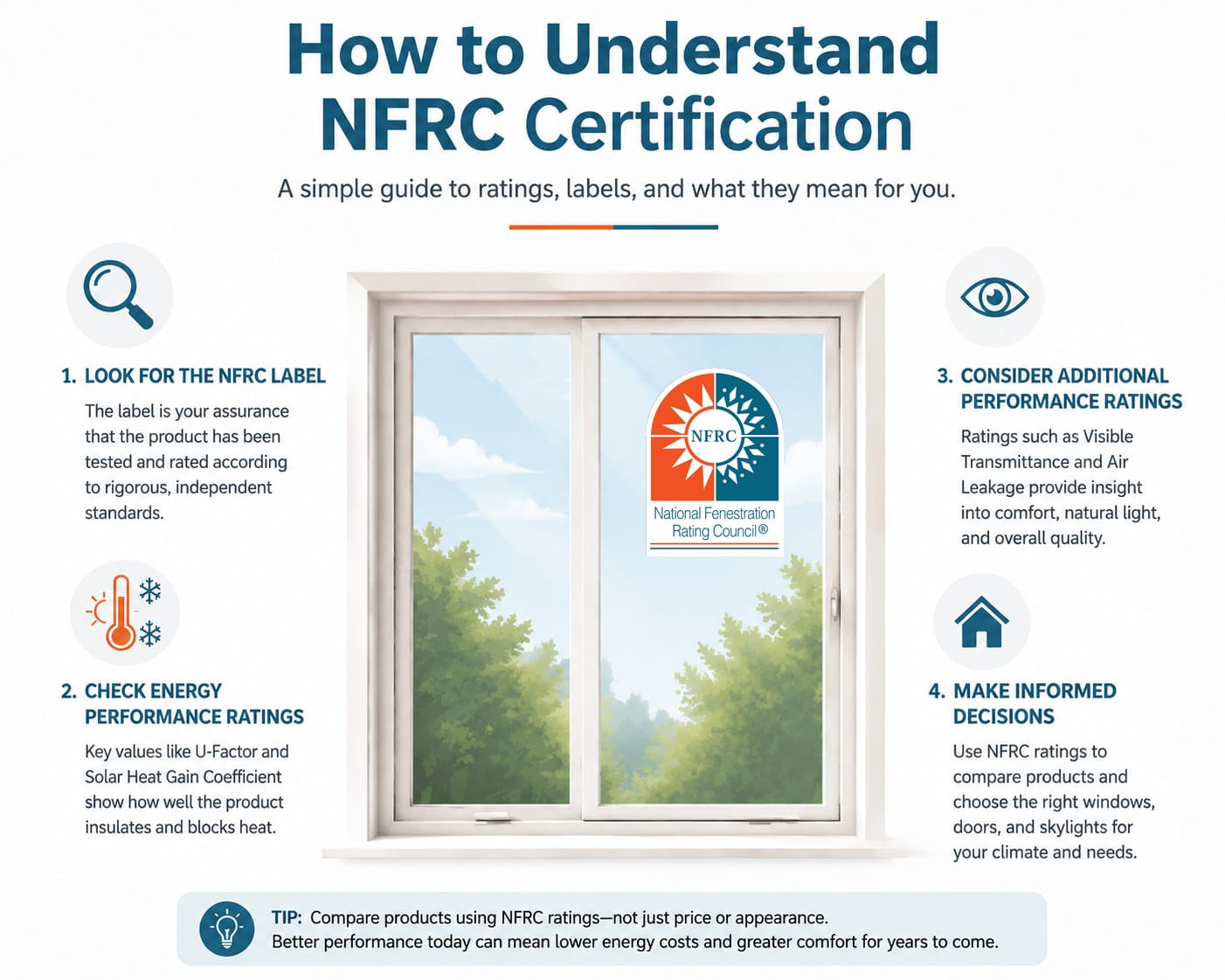
The NFRC label isn’t a wall of confusing numbers—it contains four data points you can use directly in a selection decision: U-Factor for insulation, SHGC for solar heat control, VT for daylight, and AL for air sealing.
Once you understand these four values, you can quickly judge whether a window fits your climate and project requirements.
1. What Is NFRC Certification?
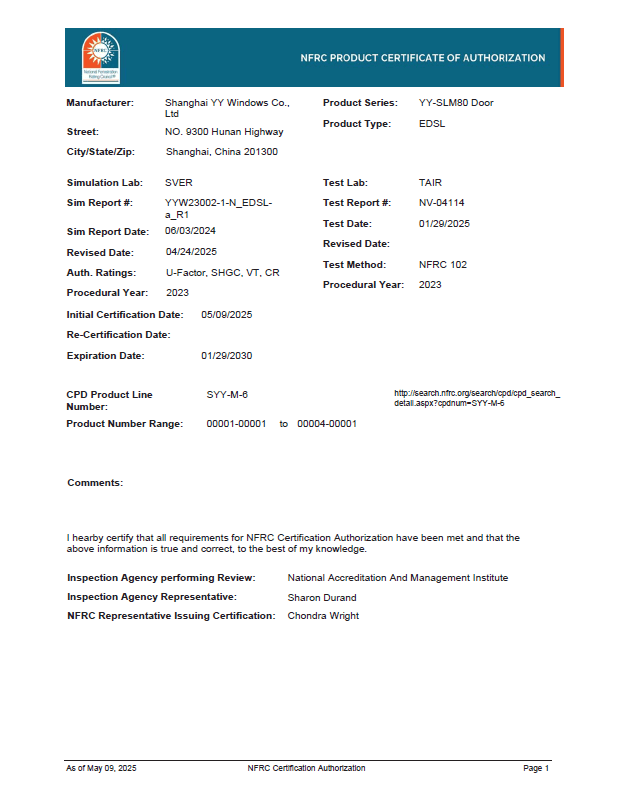
NFRC (National Fenestration Rating Council) is an independent, nonprofit, third-party body that tests, simulates, and labels the energy performance of windows, doors, and skylights.
It exists to solve a practical problem: before NFRC, manufacturers published their own “efficiency numbers” using inconsistent methods, making it difficult for buyers to compare products fairly.
NFRC standardized the testing procedures and label format so that any two windows can be compared using the same set of performance values.
2. What Does the NFRC Label Look Like? A Section-by-Section Breakdown
A complete NFRC label is typically organized into several clear sections:
- Top: The NFRC logo and the word “Certified,” confirming that the product has been rated through NFRC’s certification process.
- Middle-left: The manufacturer name, product line, product type—such as a window or glass door—and a brief specification description.
- Middle-right: The core performance values, including U-Factor, Solar Heat Gain Coefficient (SHGC), Visible Transmittance (VT), and Air Leakage (AL), where applicable.
- Bottom: Certification information and, in some cases, applicable ENERGY STAR climate-zone guidance.
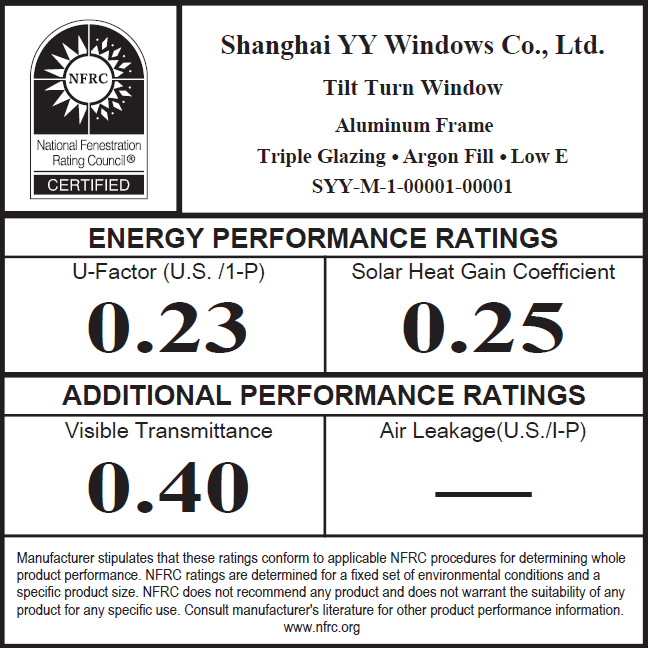
When you receive an NFRC label, check it in order. First, confirm that the product information matches what was purchased. Next, review the four performance values. Finally, check whether the label includes any applicable climate-zone information.
3. What Do the 4 Key Numbers Actually Mean?
U-Factor: How Well the Product Insulates
U-Factor measures how well a window resists heat transfer. The lower the value, the better the insulation. A lower U-Factor means less heat escapes during winter or enters through conduction during summer.
Typical values range approximately from 0.20 to 1.20. Buyers in cold climates usually prioritize a low U-Factor to reduce winter heat loss. In cooling-dominated climates such as Florida, U-Factor still matters, but it is typically a secondary consideration behind SHGC.
Selection rule: A lower U-Factor generally means better insulation performance.
SHGC: How Much Solar Heat Enters the Building
Solar Heat Gain Coefficient (SHGC) measures the fraction of solar radiation that passes through a window and becomes heat indoors. It is expressed on a scale from 0 to 1.
The lower the SHGC, the more effectively the product limits solar heat gain. In cooling-dominated climates such as Florida, SHGC is often the value to prioritize because it directly affects air-conditioning loads and indoor comfort.
Selection rule: A lower SHGC generally provides better solar-heat control.
Visible Transmittance: How Much Daylight Passes Through
Visible Transmittance (VT) also ranges from 0 to 1. The higher the value, the more visible light passes through the window and the brighter the interior feels under natural daylight.
Selecting VT often involves balancing daylight and solar control. A higher VT can provide a brighter interior, but it may sometimes be associated with a higher SHGC depending on the glazing configuration.
Selection rule: A higher VT means more visible daylight, but the value should be considered together with SHGC.
Air Leakage: How Well the Product Seals
Air Leakage (AL) measures the amount of air infiltration through the product per unit area. The lower the value, the tighter the window or door seals.
A lower Air Leakage value means less uncontrolled air movement and less unwanted heat exchange between indoor and outdoor environments. Typical values fall approximately between 0.1 and 0.3. Air Leakage is optional on some NFRC labels rather than mandatory.
Selection rule: A lower Air Leakage value generally indicates better air-sealing performance.
4. In Florida or Southern Climates, Which Number Should You Prioritize?
Florida has a cooling-dominated climate, with high temperatures, high humidity, and strong solar exposure throughout much of the year.
For projects in Florida, SHGC is usually the value to check first.
A lower SHGC means less solar heat enters the building, which can reduce cooling demand and improve indoor comfort.
U-Factor still matters, but it typically has less influence on overall energy use than SHGC in this climate. VT should be evaluated separately according to the project’s daylighting requirements. It is not always advisable to sacrifice too much natural light solely to achieve a lower SHGC.
Exact target values vary according to the project type, building orientation, glazing package, and applicable energy code. It is best to compare the product’s actual NFRC data with the project’s climate zone instead of relying on a single “ideal” value for every application.
5. What Are the Specific NFRC Value Requirements Across North America?
Important clarification: NFRC itself does not establish a universal pass-or-fail threshold. Its role is to test, certify, and label the product’s actual performance values.
Specific U-Factor and SHGC requirements are established by programs such as ENERGY STAR and by applicable local energy codes. These programs use NFRC-tested data to determine whether a product meets their qualification requirements.
The U.S. ENERGY STAR program divides the country into four climate zones. Each zone has different window-performance requirements under ENERGY STAR Version 7.0:
| Climate Zone | U-Factor Lower is better | SHGC | Example Coverage |
|---|---|---|---|
| Northern | ≤ 0.22 | ≥ 0.17 minimum* | Great Lakes, Northeast, and northern Midwest |
| North-Central | ≤ 0.25 | ≤ 0.40 | Most of the Midwest and parts of the Mid-Atlantic |
| South-Central | ≤ 0.28 | ≤ 0.23 | Texas, Oklahoma, and other south-central states |
| Southern | ≤ 0.32 | ≤ 0.23 | Florida, the Gulf Coast, and other southern states |
*The Northern climate zone also permits equivalent-energy-performance alternatives in which a higher U-Factor may be paired with a higher SHGC. Confirm the applicable criteria before specifying or submitting a product.
Notice that Florida’s Southern climate zone has the same strict SHGC requirement of ≤ 0.23 as the South-Central zone, but a more relaxed U-Factor threshold of ≤ 0.32. This supports the point made in the previous section: for projects in Florida, SHGC is usually the value to check first.
For projects in Canada: Canada commonly uses an Energy Rating (ER), a combined value that considers U-Factor, SHGC, and air-tightness performance. Confirm the applicable Canadian requirements for the project location before selecting a product.